
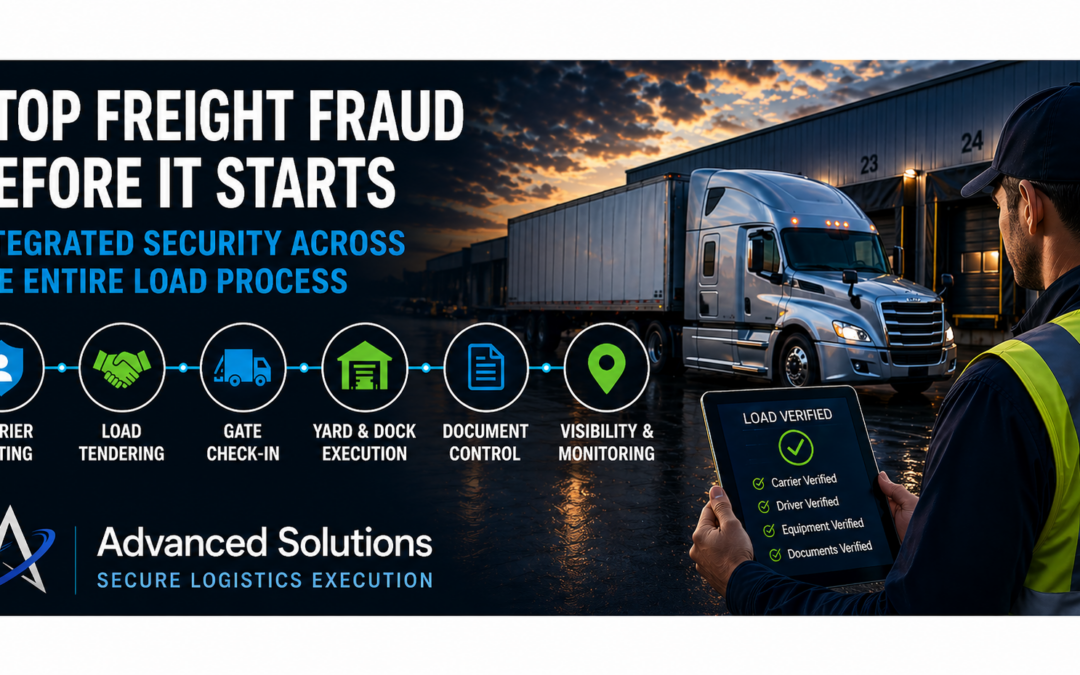
Cargo fraud and theft are no longer isolated transportation problems. They are process failures that exploit gaps between carrier vetting, load tendering, gate security, yard execution, document control, and shipment visibility.
That is why a single point solution will not stop them. Only integrated solutions can.
The problem is not just paperwork. The problem is not just visibility. The problem is not just carrier identity. Freight fraud and cargo theft occur across multiple points in the transportation process. That means the solution cannot be limited to one document, one carrier record, one tracking device, or one after-the-fact alert.
What we are seeing now is a wave of piecemeal solutions being offered by transportation providers, software vendors, and industry groups. Some of these tools may solve a small part of the problem, but they do not solve the larger issue.
For example, using our encrypted eBOL, or another third-party document verification tool, may help confirm that the Bill of Lading was not altered. That has value. But if the Bill of Lading was altered as part of a fraudulent transaction, the theft may have already occurred. Confirming that a document was changed after the freight is gone is not the same as preventing the freight from being released to the wrong party in the first place.
Shippers and the broader industry need to move upstream.
Start at the Source
To address transportation fraud and cargo theft, security must begin before the driver arrives at the gate and before the Bill of Lading is issued.
A real solution must include several connected layers:
- Carrier vetting and validation
- Load tendering and issuance controls
- Double-brokering detection
- Yard and dock security
- Driver and equipment verification
- Document control
- Visibility and exception monitoring
Each of these areas matters, but none of them is sufficient by itself. The risk is created by the gaps between them.
A carrier may appear legitimate when the load is tendered, but the driver who arrives may not match the expected carrier. The paperwork may look correct, but the equipment markings may not match. The load ID may be valid, but the pickup may have been passed through an unauthorized broker. The shipment may eventually show as “in transit,” but by then the freight may already be in the wrong hands.
This is why the process must be integrated.
Carrier Vetting Is More Than a Code
The NMFC recently announced a verified SCAC initiative. It attempts to solve a narrow problem: whether a carrier’s SCAC code is valid or associated with the party claiming to use it.
That may be useful in some circumstances, but it does not solve the larger security problem. In practical terms, many drivers may not even know what a SCAC code is. More importantly, a verified SCAC is not the same thing as a secure transaction.
No serious shipper should be handing over freight merely because someone provides a SCAC code.
There are stronger sources of carrier validation. DOT numbers are issued and maintained through government systems. MC numbers are tied to public regulatory records. Corporate information is also available through public sources and can be readily accessed. Together, these sources can be used to verify much more than a carrier name or code.
With DOT, MC corporate information and yes maybe the SCAC code a shipper can evaluate:
- Carrier identity
- Operating authority
- Equipment ownership
- Fleet size
- Safety history
- Accident records
- Types of freight the carrier is authorized to transport
- Whether the carrier’s profile aligns with the load being tendered
This creates a better foundation for carrier validation.
The key touchpoint is load tendering. When a shipper is considering a carrier for a load, the carrier’s information should be validated and the relevant checks should be automated.
In our solutions, we access these sources and bring the relevant data points together directly within the load tendering process. Risk indicators are identified and made visible before the transaction moves forward. The objective is not to let AI blindly decide whether a carrier should be used. The objective is to give the load planner the carrier intelligence needed to make an informed decision before the load is awarded or released.
There is no guessing.
If a carrier has a high accident record, a customer may still decide to use that carrier. That is their business decision. But the important point is that the decision is informed. The transportation team is not relying on an assumption, a familiar name, or a single code. They are seeing the risk before the load is released.
Yes, some illegitimate carriers register DOT numbers. That is true. But because this information is public and connected to other government and commercial records, it can be cross-checked against other data sources. That gives shippers a more complete picture of the carrier, its capabilities, and its risk profile.
A single identifier is not security. A complete validation process is security.
But that is still not enough.
Security Must Be Built Into the Load Process
Carrier vetting cannot stop at tendering. As the load moves from planning to pickup or delivery, the system should continue validating the load and pickup information. The carrier, equipment, driver, appointment, and shipment data should all be connected. Each step should reinforce the prior step.
When the driver arrives to pick up or drop off a load, the system should verify key information again so that gate, yard, dock, and transportation personnel are informed.
Does the load ID match?
Do the DOT markings on the tractor match the expected carrier?
Is the MC number valid?
Does the driver’s license appear consistent with the carrier and pickup?
Is the driver using unexpected equipment?
Is the pickup information inconsistent with the tendered load?
Has the load been reassigned in a way that suggests double brokering?
These are the kinds of checks that matter at the moment freight is actually being transferred.
In one recent example, something as simple as an expired driver’s license was identified by our enterprise Kiosk and the load pickup didnt have the chance to be denied since the driver immediately left, theft avoided, ware are not sure but maybe. . That may seem minor, but these small indicators are often exactly what give transportation personnel the opportunity to pause, question, verify, and prevent a larger problem.
When we developed our AdvancedDock solution we saw the gap not only in the processes but in potential for theft even in enterprise yards and docks and realized that another point solution that sent data back and forth from a company ERP was not the answer it needed to be integrated so that we could provide more then just yard management but corporate yard intelligence..
Informing People, Not Replacing Judgment
The goal is not to automate every decision or block every transaction automatically. That would create operational problems and unnecessary friction.
The goal is to inform the people responsible for the transaction.
A good system should identify risks, present them clearly, and allow trained personnel to make the right decision. Sometimes the right decision is to proceed. Sometimes it is to escalate. Sometimes it is to hold the load until the carrier, driver, equipment, or paperwork can be verified.
The important point is that the decision happens before the freight leaves the facility.
Our solutions are designed to stop fraud and theft before they occur, not merely document them afterward.
Visibility Alone Is Too Late
This is also why visibility solutions, by themselves, are not enough.
Visibility has value. Every shipper wants to know where freight is, when it will arrive, and whether there are delays. But visibility is not the same thing as security.
If freight is stolen by an impersonating carrier, there may be no legitimate visibility to track. If the wrong party picked up the load, the system may show a shipment event, but that does not mean the freight is secure. If someone places a tracker on a trailer after the wrong driver has already left, the process has already failed.
Let’s be honest: putting a LoJack-style tracker on a truck is often an attempt to solve the wrong problem.
The better solution is to stop the wrong truck, wrong driver, wrong carrier, or wrong transaction before the freight is released.
Visibility should support security. It should not be treated as a substitute for it.
The Problem Is the Gaps
Fraud thrives in the gaps.
The gap between carrier onboarding and load tendering.
The gap between tendering and appointment scheduling.
The gap between appointment scheduling and gate arrival.
The gap between gate check-in and dock assignment.
The gap between loading and document issuance.
The gap between document issuance and final release.
A point solution may cover one of those steps. But if the next step is disconnected, the risk simply moves there.
That is why a secure logistics process must connect the entire transaction from beginning to end. Carrier validation must connect to load planning. Load planning must connect to appointment scheduling. Appointment scheduling must connect to gate check-in. Gate check-in must connect to yard and dock execution. Yard and dock execution must connect to document issuance. Document issuance must connect to release controls and shipment visibility.
Only then do you have a process that can meaningfully reduce theft and fraud.
That means validating the carrier before the load is issued. It means checking the driver and equipment before the freight is released. It means controlling the Bill of Lading and shipment documents as part of the same process. It means giving transportation personnel real-time risk information at the exact point of decision.
Freight fraud and cargo theft will not be solved by one code, one document check, one tracker, or one visibility feed.
They will be solved by integrated systems that prevent bad transactions from moving forward in the first place.
That is why only an integrated, secure logistics execution solution can address the real problem while still keeping operations efficient and costs under control.
To learn more about our integrated logistics solutions, including our encrypted eBOL, AdvancedPass, eDOCS, and other innovations designed to secure and modernize transportation execution, contact us today.

Phillip Avelar is Managing Partner at Advanced Solutions in Chicago, helping SAP enterprises streamline supply chains and drive innovation. An AI and robotics enthusiast, he began working with neural networks in the 1990s and now applies that passion to solving real-world Supply chain challenges. He shares insights through blogs, publications, and conference talks.