
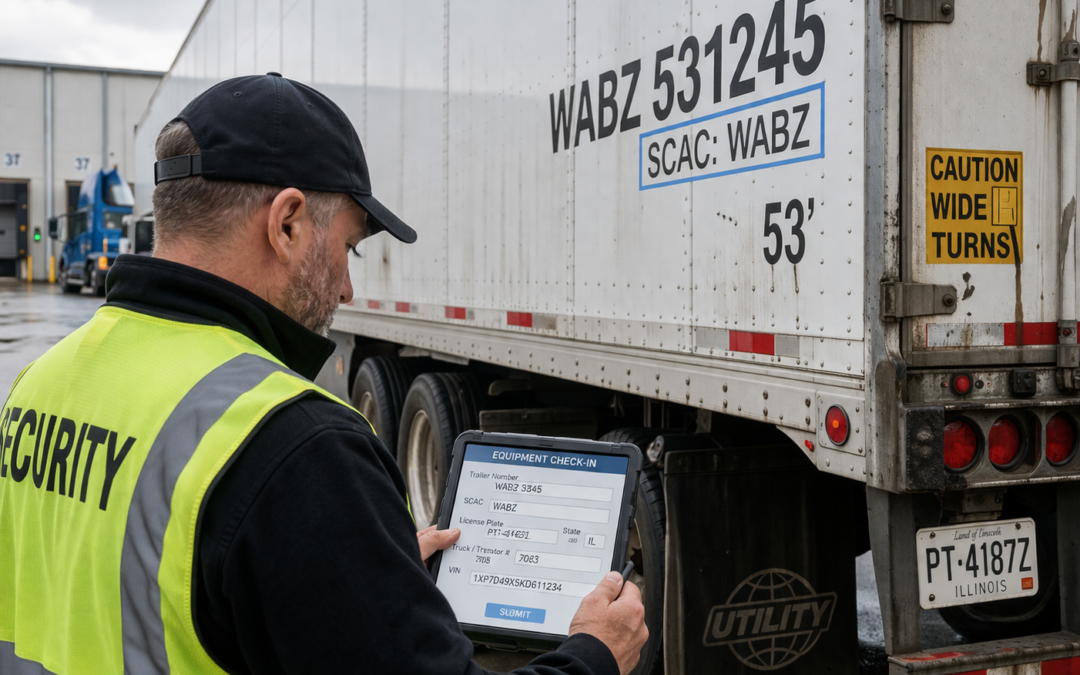
Key to preventing cargo fraud is the accurate capture and shared understanding of commercial truck identification markings. These markings support structured logistics data capture, so it is important to clearly define what they are and why they matter.
To legally operate a commercial motor vehicle in interstate commerce, certain identification information must be displayed prominently on the vehicle. At a minimum, the vehicle must show:
USDOT Number: The identification number issued by the Federal Motor Carrier Safety Administration, preceded by the letters “USDOT.”
Motor Carrier Name: The legal name, or a single trade name, of the motor carrier operating the vehicle, consistent with the carrier’s federal registration.
Standard Carrier Equipment Markings
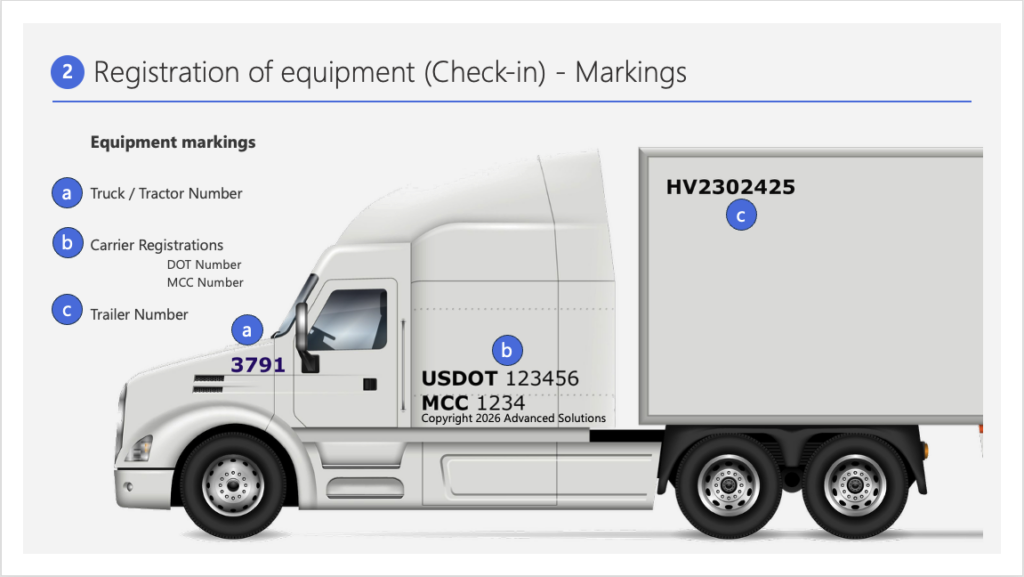
Standard Carrier Equipment Markings
Under federal rules, these markings must appear on both sides of the self-propelled commercial vehicle, typically on the cab doors. They must contrast sharply with the background and be readily legible during daylight hours from 50 feet away while the vehicle is stationary.
In day-to-day logistics operations, organizations also capture other key identifiers that may not be part of the federal door-marking requirement but are still critical for execution and traceability:
Trailer Number: The fleet-assigned identifier used to distinguish one trailer from another in yard, dock, and shipment operations. This value is a key data element used by our yard management solution, and others like it, to identify a specific piece of equipment. However, trailer numbers are not always globally unique. In some cases, the same equipment number may be used by different carriers or equipment owners. For that reason, additional identifiers such as the SCAC, USDOT number, or license plate may be needed to distinguish the equipment accurately.
Truck or Tractor Number: The internal unit number used by a carrier or private fleet to identify a specific power unit.
License Plate Number and State: A practical identifier used to confirm the specific equipment that arrived on site, especially when carrier branding or trailer numbers are unclear.
VIN: The vehicle identification number, a standardized 17-character identifier used to uniquely identify a motor vehicle.
SCAC: The Standard Carrier Alpha Code, a two- to four-letter code used to identify transportation companies in shipping and EDI workflows.
Depending on the system, these values may be labeled differently, so it is important to standardize terminology using industry norms. For example, in SAP shipment screens, the trailer number may be referred to as Trailer ID or Container ID, depending on the screen. In this context, those values refer to the same equipment identifier.
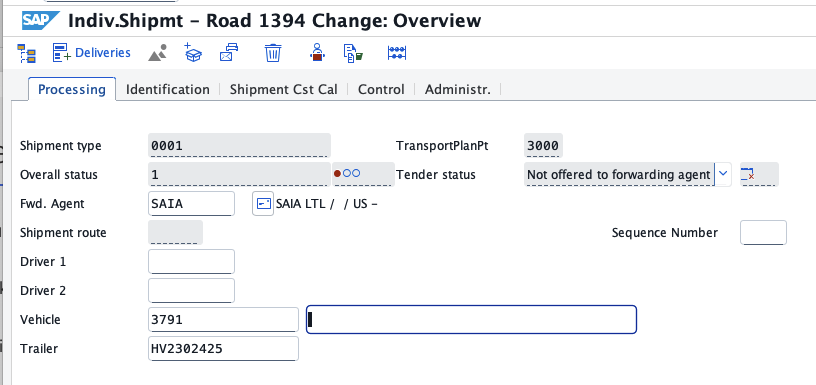
Example: Shipment with Direct Store Delivery functionality enabled.
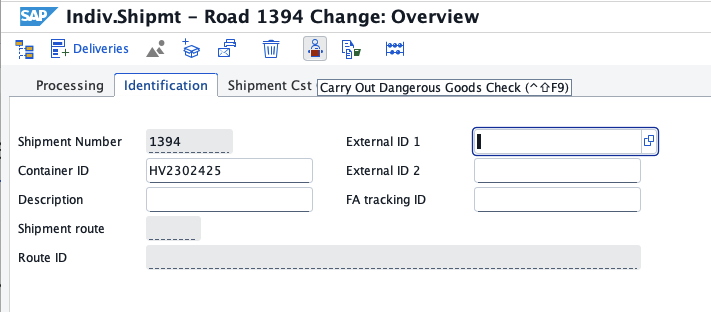
Example: Standard shipment identification screen.
Together, these identifiers provide a reliable foundation for structured data capture across transportation and warehouse processes. While the carrier name and USDOT number are central to regulatory compliance, operational identifiers such as trailer number, tractor number, license plate, VIN, and SCAC are often just as important for accurate execution, auditability, and system integration.
Fraud Prevention and Trusted Identifiers
When preventing cargo fraud, it is important not to rely equally on every identifier captured during check-in or shipment execution. Some values, such as the tractor number and trailer number, may be useful operationally, but they are also easier to duplicate. A bad actor can paint or display numbers that make equipment appear to belong to a legitimate carrier.
That is why fraud prevention should rely more heavily on trusted identifiers, with other values used in a supporting role. A license plate number is harder to fake than a painted trailer number, and when combined with the USDOT number and motor carrier name, it provides a stronger basis for validating that the equipment and carrier are legitimate. Operational identifiers still matter, but they should support validation rather than serve as the sole basis for validation.
Not all identifiers should be treated equally in a fraud-prevention process. Some should be used as primary validation points, while others should serve as supporting data.
At its core, effective cargo fraud prevention depends on structured data capture and the proactive identification of anomalies before a fraudulent movement can take place. AdvancedDock is continuously enhanced to address both simple and complex fraud schemes. Stopping cargo theft before it happens is far more effective than relying on limited visibility tools that attempt to trace a shipment only after the fraud has already occurred.
Later..

Phillip Avelar is Managing Partner at Advanced Solutions in Chicago, helping SAP enterprises streamline supply chains and drive innovation. An AI and robotics enthusiast, he began working with neural networks in the 1990s and now applies that passion to solving real-world Supply chain challenges. He shares insights through blogs, publications, and conference talks.