
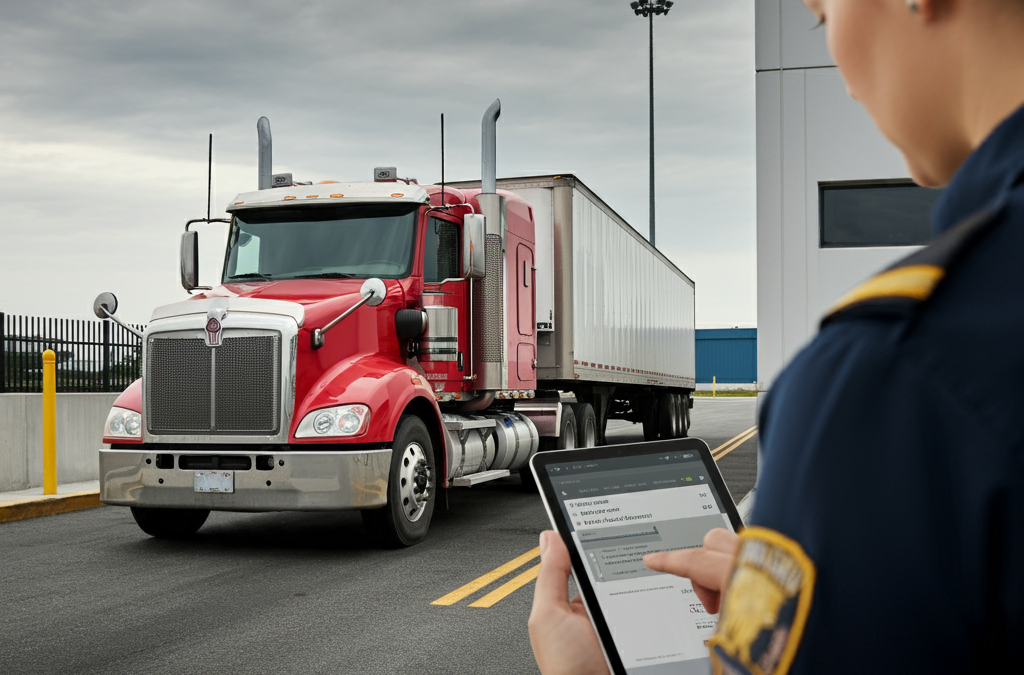
Recent reporting on several high-profile cargo thefts — including a seafood shipment valued at hundreds of thousands of dollars and destined for Costco, as well as a separate incident involving over $1 million in stolen consumer goods — has drawn renewed attention to a growing reality in logistics: most modern cargo theft no longer relies on force. It relies on exploiting process gaps.
In some cases, the tactic is deceptively simple. According to publicly available reports, individuals arrived at pickup locations claiming to represent legitimate trucking companies, using minor variations of real carrier names — subtle misspellings, formatting changes, or the addition of a hyphen. In the Costco-related incident, this visual similarity was enough to present a convincing identity. With plausible documentation and a nearly identical carrier name, the load was released.
In other cases, the setup is more sophisticated. Recent reporting describes thefts where attackers first gained access to transportation or broker systems, manipulated shipment details, and then dispatched unauthorized drivers to collect freight. The digital compromise enabled the deception — but the theft still succeeded for the same reason: the wrong party was allowed to take custody of the load at pickup.
Despite differences in technique, the outcome is identical. The shipment is released to an unauthorized individual, and the theft is not discovered until later — after the freight has already left the facility.
This pattern reflects a broader trend in cargo theft: attackers don’t need to break in or defeat physical security controls. They succeed by blending into trust-based processes and exploiting gaps in execution verification — whether those gaps originate from paperwork, visual similarity, or upstream system manipulation.
While many enterprises have invested heavily in tools to prevent cyber intrusion, the moment freight physically changes hands often relies on far less rigor. In many dock environments, verification is still driven by paper documents, visual checks, and informal trust. That gap — between digital sophistication in corporate systems and minimal enforcement of identity when accessing physical sites and picking up high-value goods — is where modern cargo theft consistently succeeds.
According to a recent report from the National Insurance Crime Bureau, cargo theft losses increased by 27 percent in 2024 and are projected to rise another 22 percent in 2025. This problem is not going away.
The Problem Isn’t Just Theft — It’s Lack of true Supply Chain Visibility
Traditional dock and shipping operations — and many of the systems that support them — still rely heavily on:
- Paper Bills of Lading
- Static pickup appointments
- Manual identity verification
- Fragmented systems with no real-time enforcement
Together, these practices create an environment where a fraudulent driver with plausible documentation can arrive, present themselves as authorized, collect a legitimate load, and exit the facility without triggering immediate concern.
In other words, the theft doesn’t require breaking in — it succeeds by blending in.
How AdvancedDock and AdvancedBOL Close the Gap
When we first developed our electronic Bill of Lading (eBOL) solution, security was a foundational requirement — not an afterthought. That focus quickly expanded beyond documents alone and into site and dock execution, because securing a load requires securing the entire handoff process.
Many traditional transportation (TMS) and dock systems are designed by carriers and brokers and reflect a carrier-centric perspective. In these models — often labeled as “visibility solutions” — nothing is actually visible until after a load has been picked up. In the above publicly reported thefts, shippers were unaware that their load was missing for days, only discovering the issue when the receiver reported that it never arrived.
Verification in these systems is assumed to occur upstream, and execution at the dock is treated as a largely procedural step. As a result, the moment where freight custody changes — the most critical point of control — is left largely unenforced.
That assumption creates a blind spot.
In the incident described above, a carrier-focused TMS or supply-chain visibility platform would not flag the pickup as suspicious. The load existed. The appointment existed. A driver arrived with plausible credentials. From the system’s perspective, execution appeared valid at the moment of pickup.
Because the load was released to a fraudulent party, it never entered the carrier’s execution workflow where downstream visibility and tracking would normally occur. As a result, the system had no indication that anything was wrong until the shipment failed to arrive and someone later questioned its status — even though the wrong party had already taken custody of the freight days earlier. While incidents like this occur with troubling regularity, they are rarely reported publicly, which is why detailed accounts of this nature are uncommon.
AdvancedeBOL, AdvancedDock, AdvancedPass,and AdvancedBOL and the innovative SmartSeal were designed holistically as an integrated system, where load custody, identity verification, and execution integrity are not optional — they are core requirements.
Rather than treating the dock as a passive physical location, our solutions treat it as a controlled execution environment, where authorization is enforced digitally and in real time.
A minor carrier name variation, a relabeled trailer, or visually convincing paperwork is not sufficient. If the driver, carrier, equipment, load, and appointment cannot be validated exactly within the system, execution does not proceed until verification is complete.
This highlights a fundamental difference in focus.
Carrier platforms often concentrate on stopping double brokering and optimizing routing — all valid and important efficiencies. Enterprise shippers, however, face a different responsibility. Before a load ever reaches the dock, the carrier has already been selected and contracted. At the point of execution, the priority shifts from optimization to security validation.
That means verifying that:
- The driver presented is the driver dispatched by the contracted carrier
- The driver’s identity and license are valid
- The tractor and trailer match the authorized equipment
- The load, quantities, and documentation align with what was approved
AdvancedDock performs these checks quickly and efficiently using local ML and AI models, without relying on SaaS-based APIs or external data silos. Verification happens in real time at the dock, with sensitive data remaining entirely within the enterprise.
To illustrate the risk inherent in traditional dock processes, consider a high-value retail transfer. A jewelry store would never release inventory simply because someone arrived claiming to be the courier and signed a receipt. Yet in logistics, this is effectively what happens every day: a driver arrives, claims to represent a carrier, the goods are loaded onto his trailer for his, he signs a Bill of Lading — sometimes without complete documentation — and departs with valuable cargo.
Even when a security guard is present, verification often amounts to a visual ID check and a clipboard signature — controls that create the appearance of security without meaningful enforcement.
This shift — from assumed legitimacy to verified execution — is what closes the gap that modern cargo theft exploits.
Key Protections Enabled by Modern Dock Intelligence
Verified Load-to-Driver Matching
Each load is digitally bound to:
- A specific carrier
- A specific driver
- A specific appointment window
If any element doesn’t match , the system flags it immediately — before a trailer is released.
Electronic Bills of Lading with Chain of Custody
AdvancedBOL replaces paper documents with a controlled, auditable eBOL that:
- Cannot be copied, altered, or reused
- Records timestamps, identities, and events
- Creates a verifiable chain of custody from dock to destination
This makes it virtually impossible for a fraudulent pickup to pass unnoticed.
Real-Time Dock Execution Intelligence
AdvancedDock provides live visibility into:
- Who checked in
- Which dock door was assigned
- When loading began and completed
- Who authorized the release
Evidence, Not Assumptions
If an incident occurs, customers have a complete digital record to support investigations, disputes, insurance claims, and law enforcement inquiries — not reconstructed timelines from paper logs.
Any deviation from the expected process becomes immediately visible — not after the fact.
Theft Prevention Is a Byproduct of Better Execution
AdvancedDock and AdvancedBOL were not built solely to prevent theft. They were built to improve execution, accountability, and visibility in the supply chain.
The result is that many modern cargo theft techniques — including impersonation-based pickups like those described in recent reports — simply cannot succeed in an environment where every action is verified, recorded, and enforced in real time.
Experience Over Hype
AdvancedDock and AdvancedBOL were not built solely to prevent theft. They were built to improve execution, accountability, and visibility in the supply chain.
The result is that many modern cargo theft techniques simply cannot succeed in an environment where every action is verified, recorded, and enforced in real time.
As cargo theft continues to evolve, the industry’s response cannot rely on after-the-fact tracking or manual controls. It requires systems that understand who, what, when, and why at the exact moment freight moves.
That philosophy has guided the design of Advanced Solutions from the beginning — long before cargo theft became a headline trend.
If you’d like to learn how a modern yard and dock management solution can reduce risk while improving execution through intelligence and engineered processes, contact Advanced Solutions to request a walkthrough of AdvancedDock and AdvancedBOL.
References
- From Hack to Hijack: Thieves Hit the Vape Truck, Steal $1 Million Worth of E-Cigs
- $400k worth of lobster stolen from Massachusetts warehouse
- Report on Cargo Theft - National Insurance Crime Bureau
- Cargo theft events stay stable in number, but financial loss jumps 60%
- Rash of Cargo thefts continues
- Theft of Bluetooth speakers from Memphis warehouse

Phillip Avelar is Managing Partner at Advanced Solutions in Chicago, helping SAP enterprises streamline supply chains and drive innovation. An AI and robotics enthusiast, he began working with neural networks in the 1990s and now applies that passion to solving real-world Supply chain challenges. He shares insights through blogs, publications, and conference talks.